History of geometry
From Wikipedia, the free encyclopedia

| Geometry |
|---|

|
|
| Geometers |

Geometry (from the Ancient Greek: γεωμετρία; geo- "earth", -metron "measurement") arose as the field of knowledge dealing with spatial relationships. Geometry was one of the two fields of pre-modern mathematics, the other being the study of numbers (arithmetic).
Classic geometry was focused in compass and straightedge constructions. Geometry was revolutionized by Euclid, who introduced mathematical rigor and the axiomatic method still in use today. His book, The Elements is widely considered the most influential textbook of all time, and was known to all educated people in the West until the middle of the 20th century.[1]
In modern times, geometric concepts have been generalized to a high level of abstraction and complexity, and have been subjected to the methods of calculus and abstract algebra, so that many modern branches of the field are barely recognizable as the descendants of early geometry. (See Areas of mathematics and Algebraic geometry.)
Early geometry[edit]
The earliest recorded beginnings of geometry can be traced to early peoples, who discovered obtuse triangles in the ancient Indus Valley (see Harappan Mathematics), and ancient Babylonia (see Babylonian mathematics) from around 3000 BC. Early geometry was a collection of empirically discovered principles concerning lengths, angles, areas, and volumes, which were developed to meet some practical need in surveying, construction, astronomy, and various crafts. Among these were some surprisingly sophisticated principles, and a modern mathematician might be hard put to derive some of them without the use of calculus. For example, both the Egyptians and the Babylonians were aware of versions of the Pythagorean theorem about 1500 years before Pythagoras and the Indian Sulba Sutras around 800 B.C. contained the first statements of the theorem; the Egyptians had a correct formula for the volume of a frustum of a square pyramid;
Egyptian geometry[edit]
Main article: Egyptian geometry
The ancient Egyptians knew that they could approximate the area of a circle as follows:[2]
-
-
-
- Area of Circle ≈ [ (Diameter) x 8/9 ]2.
-
-
Problem 30 of the Ahmes papyrus uses these methods to calculate the area of a circle, according to a rule that the area is equal to the square of 8/9 of the circle's diameter. This assumes that π is 4×(8/9)² (or 3.160493...), with an error of slightly over 0.63 percent. This value was slightly less accurate than the calculations of the Babylonians (25/8 = 3.125, within 0.53 percent), but was not otherwise surpassed until Archimedes' approximation of 211875/67441 = 3.14163, which had an error of just over 1 in 10,000.
Interestingly, Ahmes knew of the modern 22/7 as an approximation for π, and used it to split a hekat, hekat x 22/x x 7/22 = hekat; however, Ahmes continued to use the traditional 256/81 value for π for computing his hekat volume found in a cylinder.
Problem 48 involved using a square with side 9 units. This square was cut into a 3x3 grid. The diagonal of the corner squares were used to make an irregular octagon with an area of 63 units. This gave a second value for π of 3.111...
The two problems together indicate a range of values for π between 3.11 and 3.16.
Problem 14 in the Moscow Mathematical Papyrus gives the only ancient example finding the volume of a frustum of a pyramid, describing the correct formula:

Babylonian geometry[edit]
Main article: Babylonian mathematics
The Babylonians may have known the general rules for measuring areas and volumes. They measured the circumference of a circle as three times the diameter and the area as one-twelfth the square of the circumference, which would be correct if π is estimated as 3. The volume of a cylinder was taken as the product of the base and the height, however, the volume of the frustum of a cone or a square pyramid was incorrectly taken as the product of the height and half the sum of the bases. The Pythagorean theorem was also known to the Babylonians. Also, there was a recent discovery in which a tablet used π as 3 and 1/8. The Babylonians are also known for the Babylonian mile, which was a measure of distance equal to about seven miles today. This measurement for distances eventually was converted to a time-mile used for measuring the travel of the Sun, therefore, representing time.[3] There have been recent discoveries showing that ancient Babylonians may have discovered astronomical geometry nearly 1400 years before Europeans did.[4]
Vedic India[edit]

The Indian Vedic period had a tradition of geometry, mostly expressed in the construction of elaborate altars. Early Indian texts (1st millennium BC) on this topic include the Satapatha Brahmana and the Śulba Sūtras.[5][6][7]
According to (Hayashi 2005, p. 363), the Śulba Sūtras contain "the earliest extant verbal expression of the Pythagorean Theorem in the world, although it had already been known to the Old Babylonians."
They contain lists of Pythagorean triples,[9] which are particular cases of Diophantine equations.[10] They also contain statements (that with hindsight we know to be approximate) about squaring the circle and "circling the square."[11]
The Baudhayana Sulba Sutra, the best-known and oldest of the Sulba Sutras (dated to the 8th or 7th century BC) contains examples of simple Pythagorean triples, such as: , , , , and [12] as well as a statement of the Pythagorean theorem for the sides of a square: "The rope which is stretched across the diagonal of a square produces an area double the size of the original square."[12] It also contains the general statement of the Pythagorean theorem (for the sides of a rectangle): "The rope stretched along the length of the diagonal of a rectangle makes an area which the vertical and horizontal sides make together."[12]


According to mathematician S. G. Dani, the Babylonian cuneiform tablet Plimpton 322 written c. 1850 BC[13] "contains fifteen Pythagorean triples with quite large entries, including (13500, 12709, 18541) which is a primitive triple,[14] indicating, in particular, that there was sophisticated understanding on the topic" in Mesopotamia in 1850 BC. "Since these tablets predate the Sulbasutras period by several centuries, taking into account the contextual appearance of some of the triples, it is reasonable to expect that similar understanding would have been there in India."[15] Dani goes on to say:
In all, three Sulba Sutras were composed. The remaining two, the Manava Sulba Sutra composed by Manava (fl. 750-650 BC) and the Apastamba Sulba Sutra, composed by Apastamba (c. 600 BC), contained results similar to the Baudhayana Sulba Sutra.
Greek geometry[edit]
See also: Greek mathematics
Classical Greek geometry[edit]
For the ancient Greek mathematicians, geometry was the crown jewel of their sciences, reaching a completeness and perfection of methodology that no other branch of their knowledge had attained. They expanded the range of geometry to many new kinds of figures, curves, surfaces, and solids; they changed its methodology from trial-and-error to logical deduction; they recognized that geometry studies "eternal forms", or abstractions, of which physical objects are only approximations; and they developed the idea of the "axiomatic method", still in use today.
Thales and Pythagoras[edit]

Thales (635-543 BC) of Miletus (now in southwestern Turkey), was the first to whom deduction in mathematics is attributed. There are five geometric propositions for which he wrote deductive proofs, though his proofs have not survived. Pythagoras (582-496 BC) of Ionia, and later, Italy, then colonized by Greeks, may have been a student of Thales, and traveled to Babylon and Egypt. The theorem that bears his name may not have been his discovery, but he was probably one of the first to give a deductive proof of it. He gathered a group of students around him to study mathematics, music, and philosophy, and together they discovered most of what high school students learn today in their geometry courses. In addition, they made the profound discovery of incommensurable lengths and irrational numbers.
Plato[edit]
Plato (427-347 BC) is a philosopher that is highly esteemed by the Greeks. There is a story that he had inscribed above the entrance to his famous school, "Let none ignorant of geometry enter here." However, the story is considered to be untrue.[16] Though he was not a mathematician himself, his views on mathematics had great influence. Mathematicians thus accepted his belief that geometry should use no tools but compass and straightedge – never measuring instruments such as a marked ruler or a protractor, because these were a workman’s tools, not worthy of a scholar. This dictum led to a deep study of possible compass and straightedge constructions, and three classic construction problems: how to use these tools to trisect an angle, to construct a cube twice the volume of a given cube, and to construct a square equal in area to a given circle. The proofs of the impossibility of these constructions, finally achieved in the 19th century, led to important principles regarding the deep structure of the real number system. Aristotle (384-322 BC), Plato’s greatest pupil, wrote a treatise on methods of reasoning used in deductive proofs (see Logic) which was not substantially improved upon until the 19th century.
Hellenistic geometry[edit]
Euclid[edit]


Euclid (c. 325-265 BC), of Alexandria, probably a student at the Academy founded by Plato, wrote a treatise in 13 books (chapters), titled The Elements of Geometry, in which he presented geometry in an ideal axiomatic form, which came to be known as Euclidean geometry. The treatise is not a compendium of all that the Hellenistic mathematicians knew at the time about geometry; Euclid himself wrote eight more advanced books on geometry. We know from other references that Euclid’s was not the first elementary geometry textbook, but it was so much superior that the others fell into disuse and were lost. He was brought to the university at Alexandria by Ptolemy I, King of Egypt.
The Elements began with definitions of terms, fundamental geometric principles (called axioms or postulates), and general quantitative principles (called common notions) from which all the rest of geometry could be logically deduced. Following are his five axioms, somewhat paraphrased to make the English easier to read.
- Any two points can be joined by a straight line.
- Any finite straight line can be extended in a straight line.
- A circle can be drawn with any center and any radius.
- All right angles are equal to each other.
- If two straight lines in a plane are crossed by another straight line (called the transversal), and the interior angles between the two lines and the transversal lying on one side of the transversal add up to less than two right angles, then on that side of the transversal, the two lines extended will intersect (also called the parallel postulate).
Archimedes[edit]
Archimedes (287-212 BC), of Syracuse, Sicily, when it was a Greek city-state, is often considered to be the greatest of the Greek mathematicians, and occasionally even named as one of the three greatest of all time (along with Isaac Newton and Carl Friedrich Gauss). Had he not been a mathematician, he would still be remembered as a great physicist, engineer, and inventor. In his mathematics, he developed methods very similar to the coordinate systems of analytic geometry, and the limiting process of integral calculus. The only element lacking for the creation of these fields was an efficient algebraic notation in which to express his concepts[citation needed].
After Archimedes[edit]

After Archimedes, Hellenistic mathematics began to decline. There were a few minor stars yet to come, but the golden age of geometry was over. Proclus (410-485), author of Commentary on the First Book of Euclid, was one of the last important players in Hellenistic geometry. He was a competent geometer, but more importantly, he was a superb commentator on the works that preceded him. Much of that work did not survive to modern times, and is known to us only through his commentary. The Roman Republic and Empire that succeeded and absorbed the Greek city-states produced excellent engineers, but no mathematicians of note.
The great Library of Alexandria was later burned. There is a growing consensus among historians that the Library of Alexandria likely suffered from several destructive events, but that the destruction of Alexandria's pagan temples in the late 4th century was probably the most severe and final one. The evidence for that destruction is the most definitive and secure. Caesar's invasion may well have led to the loss of some 40,000-70,000 scrolls in a warehouse adjacent to the port (as Luciano Canfora argues, they were likely copies produced by the Library intended for export), but it is unlikely to have affected the Library or Museum, given that there is ample evidence that both existed later.[17]
Civil wars, decreasing investments in maintenance and acquisition of new scrolls and generally declining interest in non-religious pursuits likely contributed to a reduction in the body of material available in the Library, especially in the 4th century. The Serapeum was certainly destroyed by Theophilus in 391, and the Museum and Library may have fallen victim to the same campaign.
Classical Indian geometry[edit]
See also: Indian mathematics
In the Bakhshali manuscript, there is a handful of geometric problems (including problems about volumes of irregular solids). The Bakhshali manuscript also "employs a decimal place value system with a dot for zero."[18] Aryabhata's Aryabhatiya (499) includes the computation of areas and volumes.
Brahmagupta wrote his astronomical work Brāhma Sphuṭa Siddhānta in 628. Chapter 12, containing 66 Sanskrit verses, was divided into two sections: "basic operations" (including cube roots, fractions, ratio and proportion, and barter) and "practical mathematics" (including mixture, mathematical series, plane figures, stacking bricks, sawing of timber, and piling of grain).[19] In the latter section, he stated his famous theorem on the diagonals of a cyclic quadrilateral:[19]
Brahmagupta's theorem: If a cyclic quadrilateral has diagonals that are perpendicular to each other, then the perpendicular line drawn from the point of intersection of the diagonals to any side of the quadrilateral always bisects the opposite side.
Chapter 12 also included a formula for the area of a cyclic quadrilateral (a generalization of Heron's formula), as well as a complete description of rational triangles (i.e. triangles with rational sides and rational areas).
Brahmagupta's formula: The area, A, of a cyclic quadrilateral with sides of lengths a, b, c, d, respectively, is given by

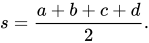
where s, the semiperimeter, given by:
Brahmagupta's Theorem on rational triangles: A triangle with rational sides and rational area is of the form:




Chinese geometry[edit]
See also: Chinese mathematics


The first definitive work (or at least oldest existent) on geometry in China was the Mo Jing, the Mohist canon of the early philosopher Mozi (470-390 BC). It was compiled years after his death by his followers around the year 330 BC.[21] Although the Mo Jing is the oldest existent book on geometry in China, there is the possibility that even older written material existed. However, due to the infamous Burning of the Books in a political maneuver by the Qin Dynasty ruler Qin Shihuang (r. 221-210 BC), multitudes of written literature created before his time were purged. In addition, the Mo Jing presents geometrical concepts in mathematics that are perhaps too advanced not to have had a previous geometrical base or mathematic background to work upon.
The Mo Jing described various aspects of many fields associated with physical science, and provided a small wealth of information on mathematics as well. It provided an 'atomic' definition of the geometric point, stating that a line is separated into parts, and the part which has no remaining parts (i.e. cannot be divided into smaller parts) and thus forms the extreme end of a line is a point.[21] Much like Euclid's first and third definitions and Plato's 'beginning of a line', the Mo Jing stated that "a point may stand at the end (of a line) or at its beginning like a head-presentation in childbirth. (As to its invisibility) there is nothing similar to it."[22] Similar to the atomists of Democritus, the Mo Jing stated that a point is the smallest unit, and cannot be cut in half, since 'nothing' cannot be halved.[22] It stated that two lines of equal length will always finish at the same place,[22] while providing definitions for the comparison of lengths and for parallels,[23] along with principles of space and bounded space.[24] It also described the fact that planes without the quality of thickness cannot be piled up since they cannot mutually touch.[25] The book provided definitions for circumference, diameter, and radius, along with the definition of volume.[26]
The Han Dynasty (202 BC-220 AD) period of China witnessed a new flourishing of mathematics. One of the oldest Chinese mathematical texts to present geometric progressions was the Suàn shù shū of 186 BC, during the Western Han era. The mathematician, inventor, and astronomer Zhang Heng (78-139 AD) used geometrical formulas to solve mathematical problems. Although rough estimates for pi (π) were given in the Zhou Li (compiled in the 2nd century BC),[27] it was Zhang Heng who was the first to make a concerted effort at creating a more accurate formula for pi. Zhang Heng approximated pi as 730/232 (or approx 3.1466), although he used another formula of pi in finding a spherical volume, using the square root of 10 (or approx 3.162) instead. Zu Chongzhi (429-500 AD) improved the accuracy of the approximation of pi to between 3.1415926 and 3.1415927, with 355⁄113 (密率, Milü, detailed approximation) and 22⁄7 (约率, Yuelü, rough approximation) being the other notable approximation.[28] In comparison to later works, the formula for pi given by the French mathematician Franciscus Vieta (1540-1603) fell halfway between Zu's approximations.
The Nine Chapters on the Mathematical Art[edit]
The Nine Chapters on the Mathematical Art, the title of which first appeared by 179 AD on a bronze inscription, was edited and commented on by the 3rd century mathematician Liu Hui from the Kingdom of Cao Wei. This book included many problems where geometry was applied, such as finding surface areas for squares and circles, the volumes of solids in various three-dimensional shapes, and included the use of the Pythagorean theorem. The book provided illustrated proof for the Pythagorean theorem,[29] contained a written dialogue between of the earlier Duke of Zhou and Shang Gao on the properties of the right angle triangle and the Pythagorean theorem, while also referring to the astronomical gnomon, the circle and square, as well as measurements of heights and distances.[30]The editor Liu Hui listed pi as 3.141014 by using a 192 sided polygon, and then calculated pi as 3.14159 using a 3072 sided polygon. This was more accurate than Liu Hui's contemporary Wang Fan, a mathematician and astronomer from Eastern Wu, would render pi as 3.1555 by using 142⁄45.[31] Liu Hui also wrote of mathematical surveying to calculate distance measurements of depth, height, width, and surface area. In terms of solid geometry, he figured out that a wedge with rectangular base and both sides sloping could be broken down into a pyramid and a tetrahedral wedge.[32] He also figured out that a wedge with trapezoid base and both sides sloping could be made to give two tetrahedral wedges separated by a pyramid.[32] Furthermore, Liu Hui described Cavalieri's principle on volume, as well as Gaussian elimination. From the Nine Chapters, it listed the following geometrical formulas that were known by the time of the Former Han Dynasty (202 BCE–9 CE).


0 comments:
Post a Comment